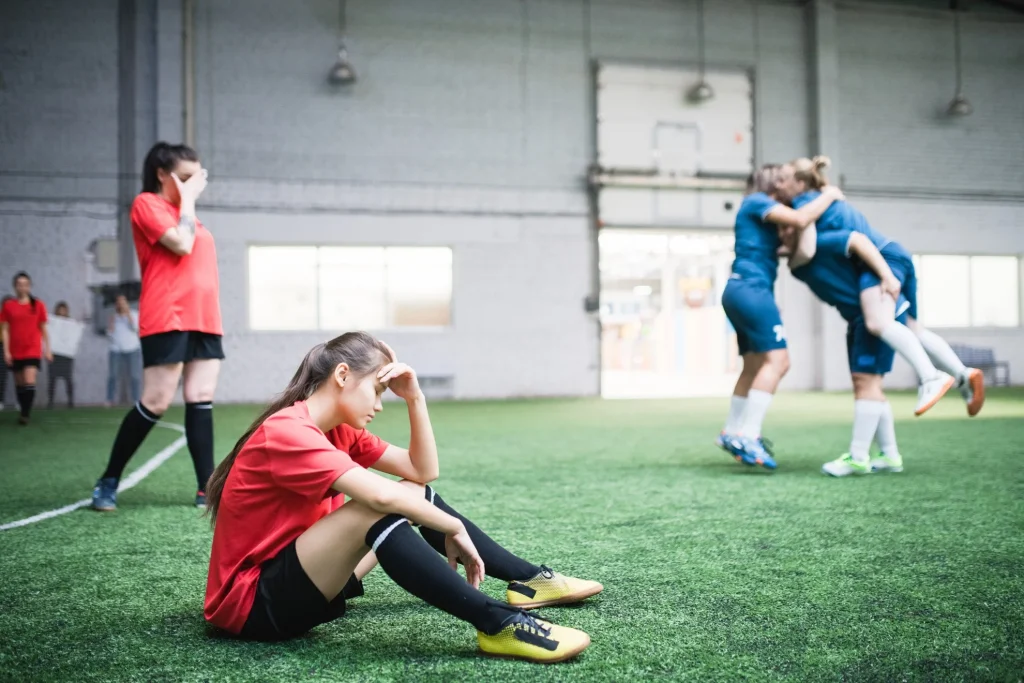

I remember the feeling all too well.
Turning up to NPL football trials, knowing that every touch, every pass and every mistake could influence whether I made the team.
I remember being told things like, “Play in the midfield, no matter what” or “Don’t play as a defender during trials.” The message was clear: I needed to stand out, get noticed and prove myself.
Suddenly, instead of simply playing football, I was thinking about what the coaches wanted to see, how I compared to the other girls and whether I was doing enough.
There was nothing quite like that feeling of uncertainty.
And looking back, I wonder how many other young girls have experienced something similar.
Why are we losing girls from sport?
Research suggests that adolescence is a particularly vulnerable period for girls’ sporting participation.
A 2022 study by Women in Sport, involving approximately 4,000 teenagers in the UK, found that 43% of teenage girls who previously enjoyed and engaged in sport had disengaged during adolescence, compared with 24% of boys.
Amongst girls who had disengaged, 68% identified fear of judgement and 61% reported a lack of confidence as reasons for not wanting to participate.
Perhaps most concerning is that these were girls who once considered themselves sporty. Girls who previously enjoyed being active.
Australian participation data also highlights a gender gap. Australian Sports Commission figures indicate that 36% of females aged 15-24 participated in sport-related activity at least weekly in 2025, compared with 50% of males.
Of course, girls leave sport for many reasons. Schoolwork, changing interests, limited opportunities, social pressures and the increasing demands of competitive sport all play a role.
But I think we also need to consider what happens psychologically when sport shifts from something girls enjoy to something they feel constantly evaluated in.
Playing to succeed compared to playing to avoid mistakes
Performance anxiety is not necessarily about lacking ability.
Sometimes, it is about becoming so concerned with the outcome that we lose sight of the process.
Instead of concentrating on positioning, communicating with teammates or making confident decisions, attention shifts towards avoiding mistakes, impressing coaches and worrying about selection.
A player who normally takes risks might suddenly pass the ball away quickly. Someone who usually communicates confidently may become quiet. An athlete who plays freely at training might become hesitant during competition.
This is the difference between playing to succeed and playing to avoid failure.
Importantly, confidence does not have to come before confident behaviour. Young athletes can learn to make decisions, take appropriate risks and recover from mistakes even when they feel nervous.
Beyond the sporting field
The same young girl who worries about making a representative team may also worry about achieving a particular exam result, disappointing her parents or saying the wrong thing in a friendship or relationship.
Although the situations differ, the underlying concern can be remarkably similar:
What if I’m not good enough? What if I get it wrong? What will other people think?
This is why I see performance psychology as something much broader than improving sporting results.
It is about helping young people develop confidence, emotional regulation and the ability to tolerate uncertainty across different areas of their lives.
I often think back to those football trials. I wonder how different that experience might have felt if I had focused less on where I needed to play to get noticed and more on simply playing the football I knew how to play.
Because ultimately, confidence is not the absence of uncertainty. It is learning that you can handle uncertainty without letting it stop you from showing up.
And perhaps if we can help more young girls develop that confidence, we can help them hold on to the enjoyment that brought them to sport in the first place.